

Sunbelt: Acquisition UX & Job Discovery Experience
Sunbelt’s job search experience needed clearer structure between how users enter the system and how they evaluate opportunities. This work focused on improving navigation clarity, entry points into job listings, and overall scanability of high-volume listings.

The direction was informed by user behavior analysis and qualitative feedback from usability testing, which highlighted friction in early-stage job discovery.
Improve structure & clarity of the acquisition experience
Sunbelt’s website served multiple user groups with different intent signals, from exploratory browsing to job seeking and employer engagement. The challenge was not just visual refinement, but organizing entry points in a way that reduced friction and improved navigation clarity across audiences.

Home page search & navigation system
Focus Area
Solve brand inconsistency, user confusion, and unclear messaging that impact user engagement and site performance.
Align acquisition pathways with user intent while supporting multiple audience types.
Understanding how users search, evaluate, and commit to jobs
This work was grounded in qualitative and behavioral research to understand how users navigate high-volume job listings and where friction appears in early-stage discovery. The goal was to map how users move from initial search intent to evaluating and selecting relevant opportunities.

Stakeholder Meeting Outputs
Stakeholder Input
Conversations with internal stakeholders, from business leaders to recruiters helped clarify business constraints, including the need to support high-volume job postings and establishing the current user journey.
Jobs To Be Done (JTBD)
Users were not simply trying to “find jobs,” but to quickly determine whether a role was worth deeper consideration without losing time on irrelevant listings or navigation paths intended for clients. * Note: Some information has been redacted for business privacy

User Interviews
Interviews with job seekers surfaced patterns in how users describe searching for roles, including difficulty filtering relevance quickly and uncertainty when faced with dense listings. Users often relied on scanning rather than structured filtering.
Competitive Analysis
Comparisons with other job platforms highlighted more structured entry points and clearer hierarchy in listing layouts. One of our biggest questions going in, was whether or not Sunbelt wanted to hone in on their national reach or be seen as a local partner in the space.

Candidate interview results
Behavioral Observation
Reviewing browsing patterns showed inconsistent entry behavior and heavy reliance on list scanning rather than filter-driven discovery. This suggested a mismatch between system structure and user expectations.
Affinity Mapping
Research inputs from interviews, behavioral observations, and competitive analysis were synthesized into affinity clusters. The discoveries included pain points of working with staffing companies, working with recruiters, searching for jobs, and on-the-job issues.

Affinity map and retrospective
Turning research inputs into clearer job discovery structure
Research inputs from interviews, behavioral observation, stakeholder conversations, and competitive analysis were reviewed together to understand how users navigate job listings and where clarity breaks down during early discovery.
This was an opportunity to revisit what pages were necessary to keep, what needed to be restructured, and what was missing.
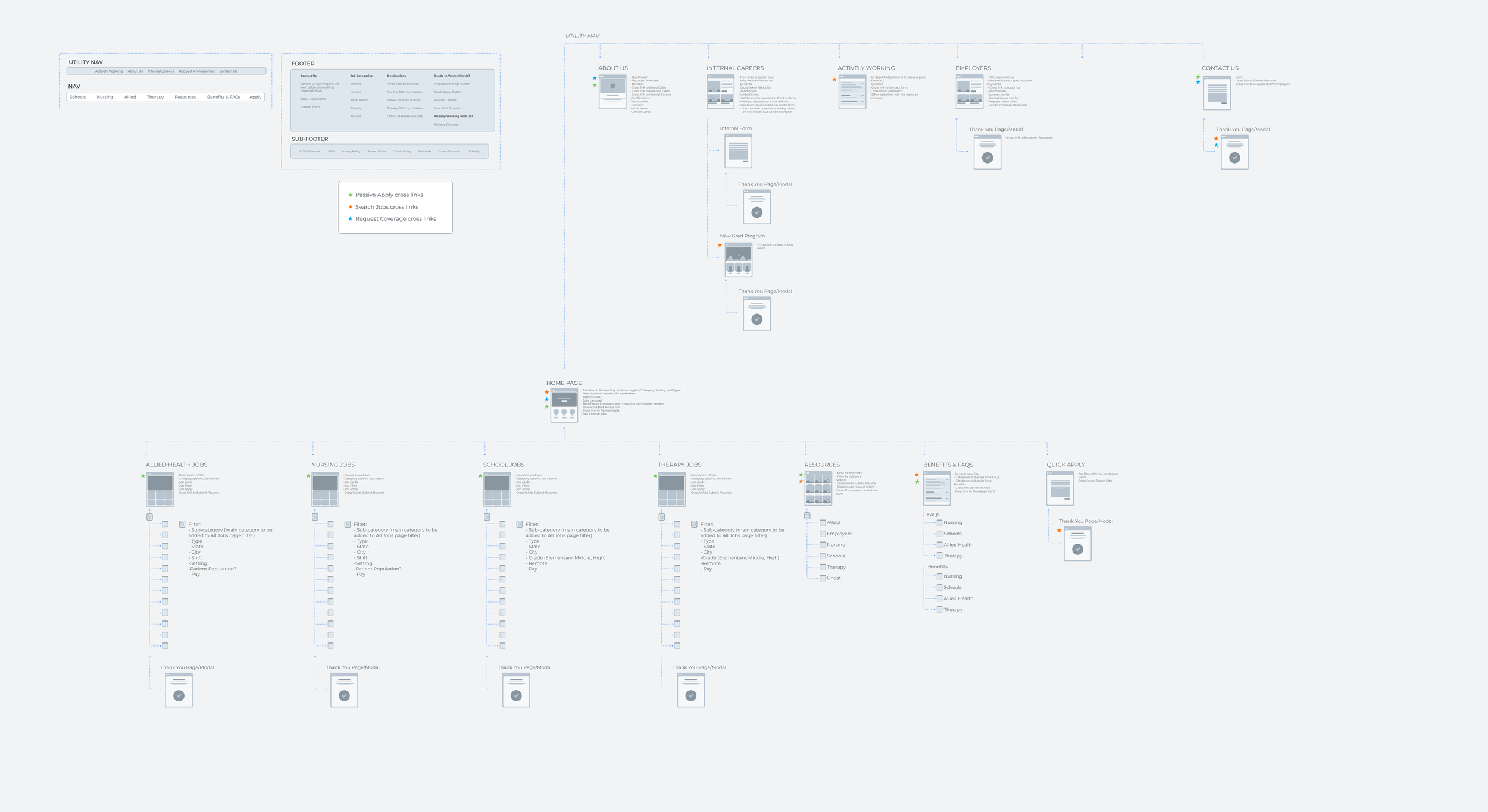
10 Years of Stacking IA
Sunbelt’s original site structure was created nearly 10 years prior and had been added onto over time.
The synthesis pointed to 3 consistent themes:
- 1
-
Inconsistent entry into job search
Users arrived at job listings through different paths, which made initial orientation within the system less predictable.
-
2
Scanning over structured evaluation
Users relied heavily on scanning listings rather than using structured filters to narrow relevance early in the process.
-
3
Segmentation needed to serve both sides. The solution had to reflect business priorities and user clarity, not one at the expense of the other.
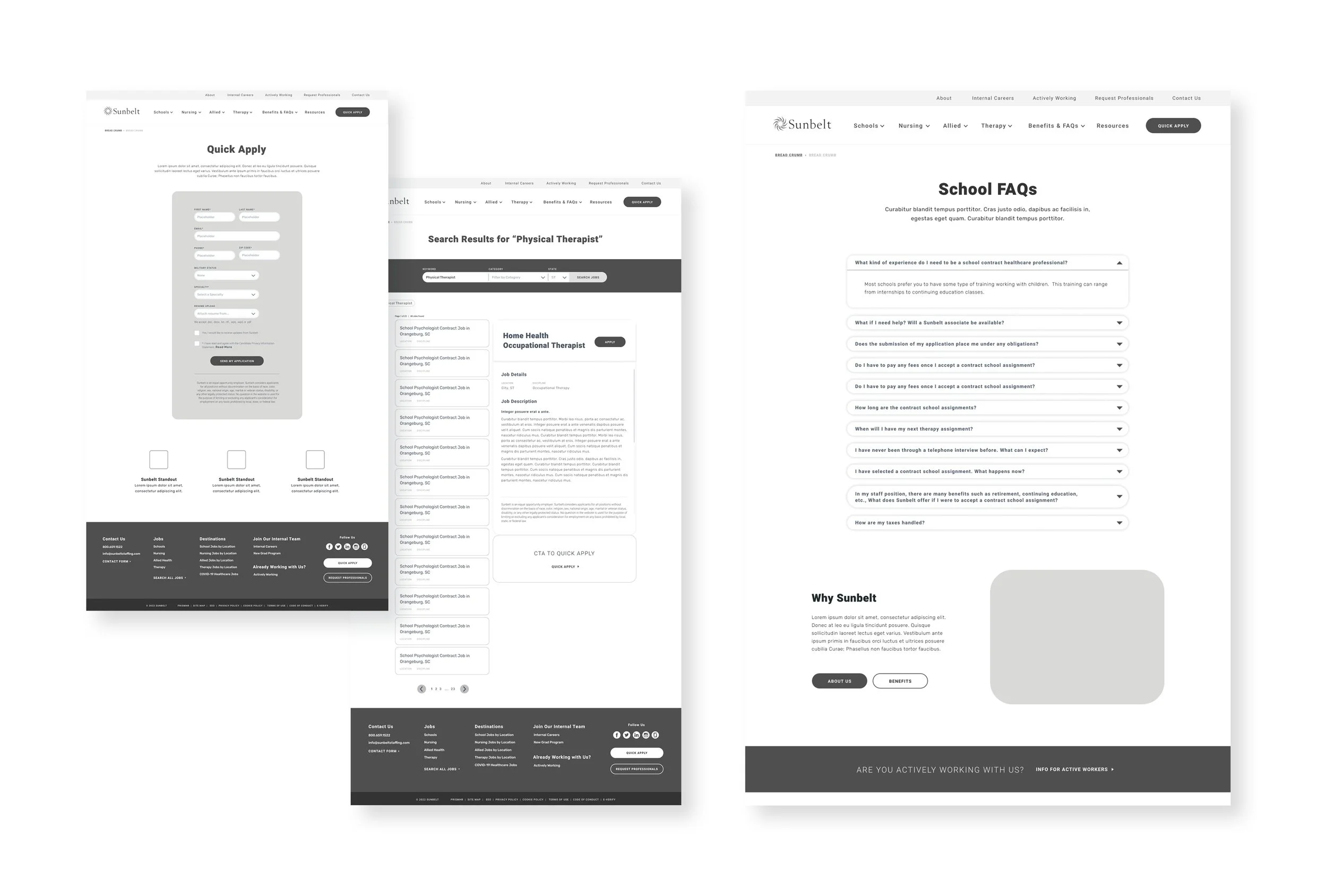
Clearer navigation through early job discovery stages
After implementation, the updated structure improved how users moved through early-stage job discovery by reducing ambiguity in entry points and making listing hierarchy easier to scan and interpret.
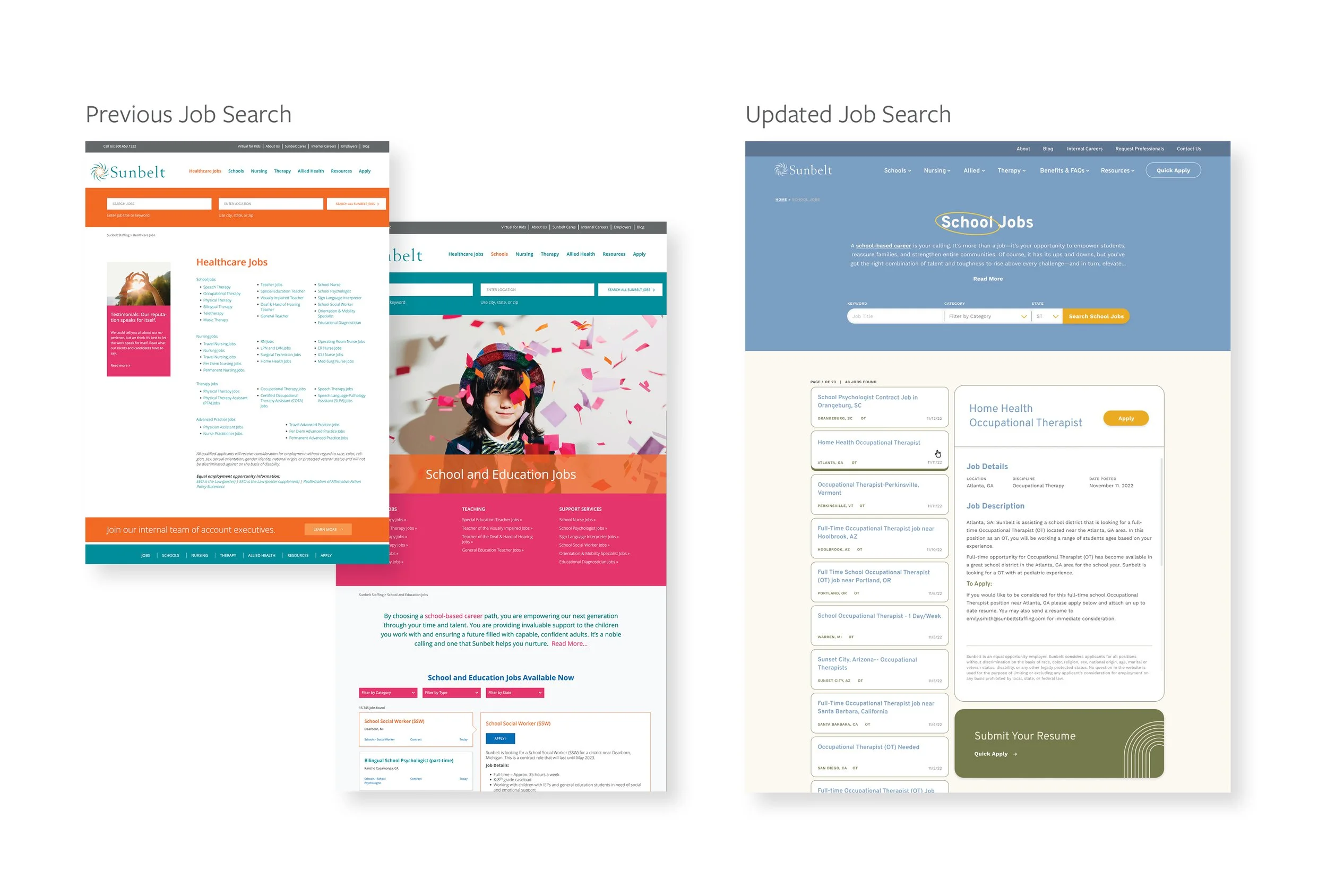
Synthesis Outcome
The most notable shift was not a change in visual design, but a clearer alignment between how users enter the system and how they evaluate job relevance within listings.
This reinforced the importance of designing acquisition experiences as structured systems, where entry behavior, scan behavior, and refinement behavior are considered together rather than in isolation.
Optimized mobile layouts ensured the experience translated smoothly to smaller screens, where many users were starting their journey.
